Notes on Painting
Reductive Geometric Abstraction
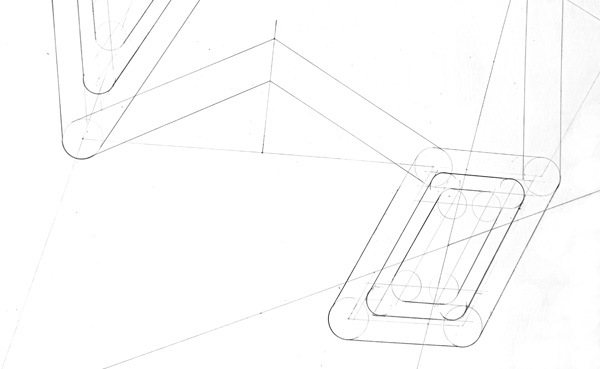
Henry Brown works with a stripped-down vocabulary of geometry and flat uniform color in his abstract paintings. Close inspection of Brown’s surfaces reveals a network of ruled lines and compass-drawn circles that form the underlying structure of his hard-edge images. He reinterprets the stable language of geometry to make paintings that shift between literal and pictorial space. Brown’s reductive aesthetic intensifies what is essential to his painting process, resulting in abstractions that are direct and conceptually driven.
Literal and Pictorial Space
Henry Brown’s abstractions are built on fixed geometry that refuses to stay fixed. His flat paintings suggest three-dimensional depth as surfaces advance and recede. The picture plane does not resolve into a stable form, forcing the eye to oscillate between competing spatial interpretations. Brown simultaneously constructs and destabilizes his own systems. He subverts illusionism with structural elements that flatten the surface, while his rigid geometric framework keeps the image in flux. Brown repurposes the stable language of geometry to create multiple representations of space that exist simultaneously.
Through this paradox, the work becomes a perceptual event that expands beyond its initial reading. What is drawn and painted on the surface appears to create depth, while remaining tied to the flat picture plane. Spatial interpretations occur when viewing the work over time and never settle. Multiple readings compete, each supported by the same structure. One reading does not eliminate another. The viewer moves between literal and pictorial space; both interpretations are plausible.
Drawing and Painting Process
Brown develops his abstract paintings by refining ideas and imagery through repeated thumbnail sketches. From the sketches, he makes scale drawings for his paintings. Henry Brown does these scale drawings on paper tacked to the wall, using compass and ruler to create the schematic and image outlines. He then lays the canvas flat on saw horses like a drafting table. Henry Brown recreates the schematics and outlines on the gessoed surface as an underdrawing, and seals it in with acrylic medium. He paints his imagery, visually integrating the unpainted drawing sections into the completed work.
In Henry Brown’s abstractions, the geometric underdrawing generates the painted image. The unpainted portions of the drawing are evidence of a prior state that Brown has preserved in the finished composition. This creates an additional level of information behind the image, and together these layers form a comprehensive unit of meaning. The geometric underdrawing is the framework for what the painting will become. The painting is the visible accumulation of its history.
Composition and Symmetry
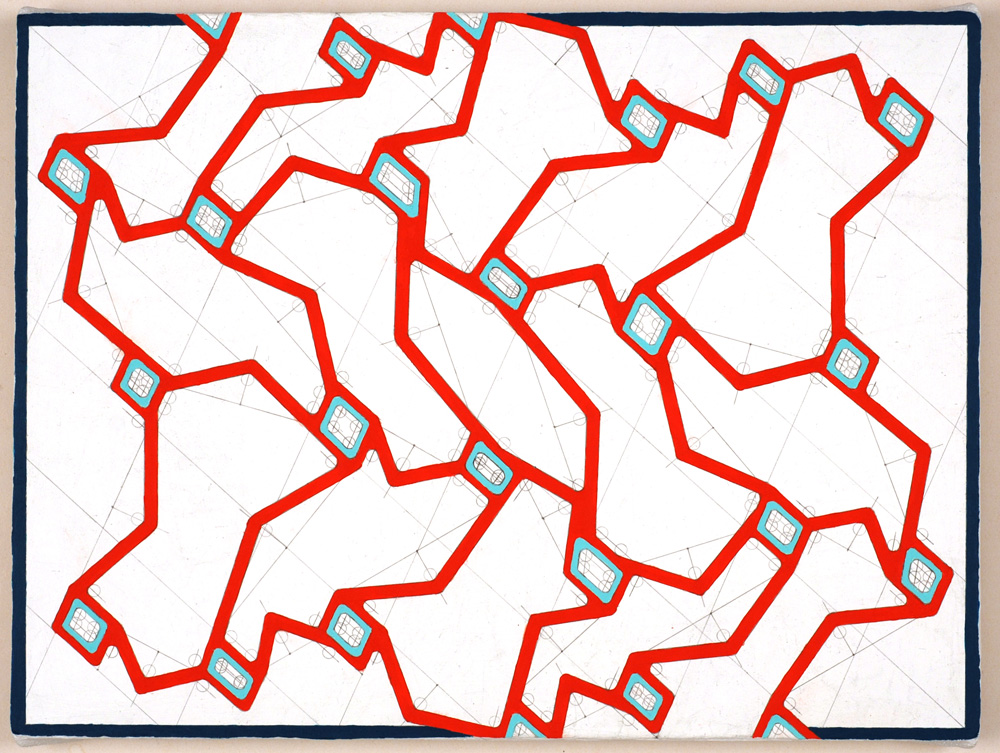
The all-over composition for Circulation seems chaotic, but it is structured around point symmetry. Each element has a counterpart that is rotated 180° around the center point of the painting, balancing the opposite sides.
White Ground
Brown constructs compass-and-ruler underdrawings on the white ground to produce his hard-edge images. The ground is a working surface, rather than space to be filled in. He leaves areas of this white layer and its drawing unpainted, incorporating them into the finished piece. The exposed ground of the canvas becomes the pictorial space against which the painted image is set. As a visual element in the work, the white ground combines the physical process of making with the painting’s optical effect in viewing.