Henry Brown
Artist Biography
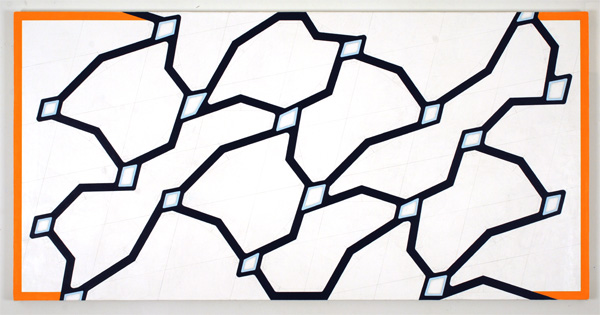
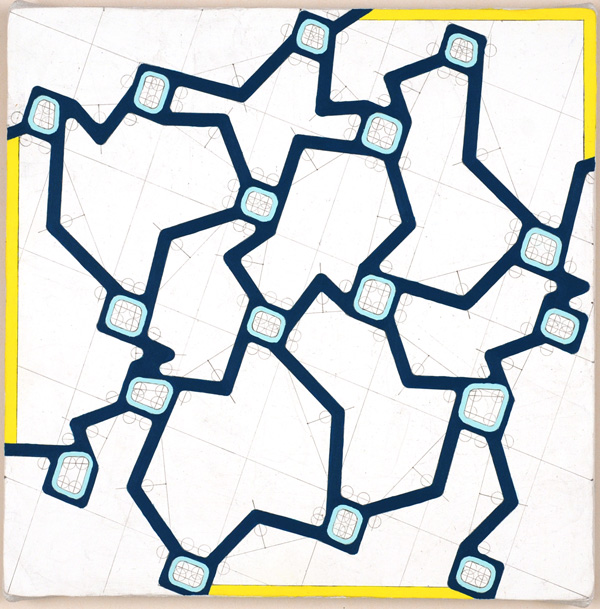
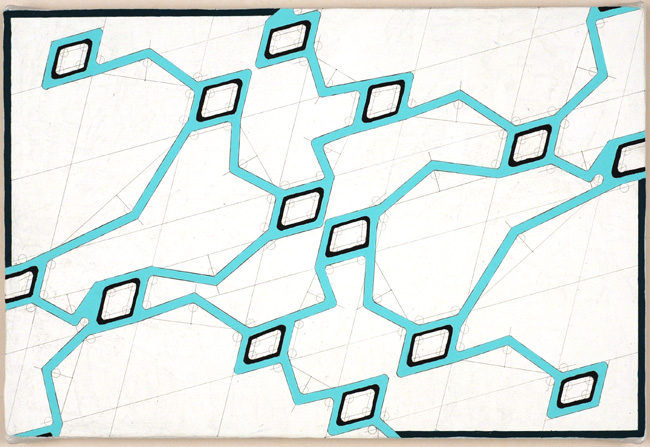
Henry Brown is an abstract painter who lives and works in New York City. He combines hard-edge geometric images with exposed compass-and-ruler underdrawings, activating perception through changing spatial relationships.
Brown’s paintings have been shown at MoMA PS 1 in Queens, NY; Shirley Fiterman Art Center, New York, NY; Anderson Gallery, Virginia Commonwealth University, Richmond, VA; Jacksonville Museum of Contemporary Art, Jacksonville, FL. Art in Embassies of the U.S. Department of State has exhibited his work in Jakarta, Indonesia; Majuro, Republic of the Marshall Islands; and Juba, Republic of South Sudan, Africa.
His has been awarded residencies at Yaddo (three times), MacDowell, and Millay Arts. Houston Public Radio KUHF’s The Front Row interviewed Henry Brown, for a traveling exhibition curated by Minus Space, Brooklyn, NY.
Brown curated a 38-artist exhibit at Westbeth Gallery, New York City and a 24-artist show at Crush Curatorial (now Hesse Flatow East), in the Hamptons on Long Island, NY.
henrybrown.com
News
In & Out of Balance. Drawing Rooms, Jersey City, NJ. October 29–November 22, 2026. Curated by Anne Trauben.
Henry Brown is included in Jakarta ASEAN 2026, a U.S. Department of State, Art in Embassies exhibition at ASEAN (Association of Southeast Asian Nations), Jakarta, Indonesia.
Black White & Gray: an Achromatic Color Exhibition. Drawing Rooms, Jersey City, NJ. June 11–July 12, 2026. Curated by Anne Trauben.
On the Grid, Off the Grid, Drawing Rooms, Jersey City, NJ. February 5–March 1, 2026. Curated by Anne Trauben.
Geometric Abstract Paintings
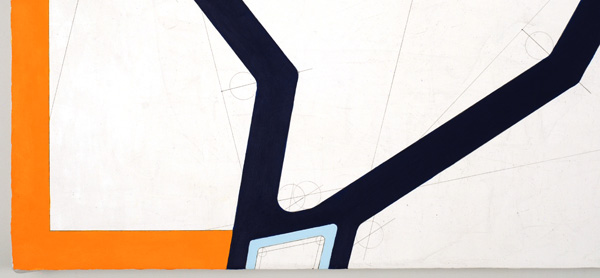
Henry Brown constructs the images for his abstract paintings from compass-and-ruler schematics drawn on the white ground. He develops these underdrawings from thumbnail sketches and full-sized versions on paper. Brown paints his imagery but leaves areas of the underdrawing exposed in the finished work. Brown’s repeating patterns and symmetry structure his compositions. Figure-ground differentiation and engagement with the painting’s edges activate his surfaces through changing spatial relationships.
The execution of his work appears meticulous, but he deviates from finished perfection. Variations in pencil lines, marks in the knifed finish of the white gesso, and eccentricities in painted edges are direct physical traces of Brown’s actions and document his facture. Henry Brown’s painting process brings incident into his hard-edge geometry.
Existing as two separate layers, the compass-and-ruler underdrawings reveal the planning behind the ordered surfaces. Taken together, the substructure and components on top function as visual elements in Henry Brown’s artwork. He combines the physical reality of painting as an object with a pictorial interpretation grounded in perceptual abstraction. The significance of the work is not just the final image, but also its creation.
Viewing at a distance enables perception of pictorial space in Henry Brown’s paintings. Imagery and illusion assert themselves, creating dynamics that produce the artwork’s bold impact. He triggers perception so that the illusion of depth challenges the flat surface plane. This actively engages the viewer with multi-dimensional space. His paintings are focal points for visual interpretation, prompting examination of the process of seeing.
At first Brown’s structured layouts read as fixed, but the appearance of depth and movement animates his imagery. Advancing and receding surfaces push the white ground back. Patterns and symmetry carry the viewer’s focus across the canvas. Both space and movement appear to be in flux. The fixed and animated readings coexist creating a visual anomaly. Henry Brown creates an open system of geometry that presents possibilities, and complexity beyond initial perception.
John Yau observes that this illusionism destabilizes the painting by transforming what seems to be a flat, static image into something in a state of change. This aspect of Brown’s work distinguishes him from previous generations of geometric artists.
(Yau and Potter 2002, 15)
References
- Yau, John, and Ted Potter. Young + Brash + Abstract. Richmond: Anderson Gallery, Virginia Commonwealth University and University of Washington Press, 2002. ISBN 0-935519-25-4.
Notes on Painting discusses Henry Brown’s work further.